The first successful pig hunt and the missed ship
Lord of the FliesThe first successful pig hunt and the missed ship form a decisive reversal: the hunters return triumphant, but their choice to leave the signal fire unattended costs the boys a chance to be seen and rescued. The scene makes the consequences of that choice visible before the hunt’s excitement can conceal them.
The Signal and the Missed Opportunity
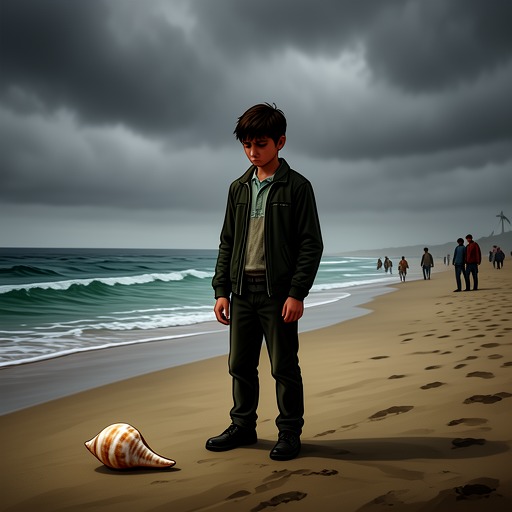
At the bathing pool, Ralph notices smoke on the horizon and shouts to the others. Piggy cannot initially see it; Simon and Maurice turn toward the sea as Ralph keeps his gaze fixed on the distant smoke and the dot beneath it, which may be a ship’s funnel. Ralph expects the vessel to see their smoke. His hope depends on the signal fire above them, and Piggy and Simon soon look toward The mountain to check that it is still burning.
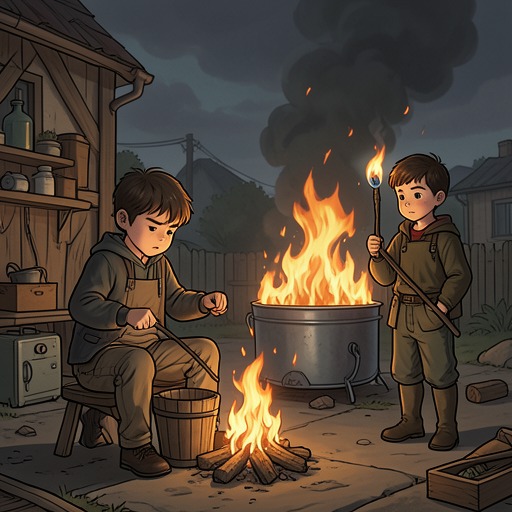
Ralph runs toward the mountain, with Simon, Maurice, and, more slowly, Piggy following. The climb brings a painful choice into focus: Ralph calls for Piggy’s glasses, which could be used to relight the fire, but hesitates over whether there is time to fetch them before the ship disappears. At the summit they find the fire entirely out, its watchers gone and a pile of unused fuel left ready. The ship’s smoke dwindles on the horizon. Ralph runs along the cliff and cries, “Come back! Come back!” The failure is not simply that the boys lack a signal; they had fuel and a duty to keep the fire going, but the hunters’ absence has left their hope of rescue unmarked.
The Hunters’ Return and the Collision of Priorities
As the boys gather on the mountain, a procession appears among the pink screes: Jack Merridew leads, while the twins carry a heavy stake with the gutted pig swinging from it. The pig’s head hangs from its gaping neck, and the hunters chant, “Kill the pig. Cut her throat. Spill her blood.” Their ritual words travel across the blackened wood and ashes, turning the successful hunt into a public triumph just as the failed signal has become undeniable.
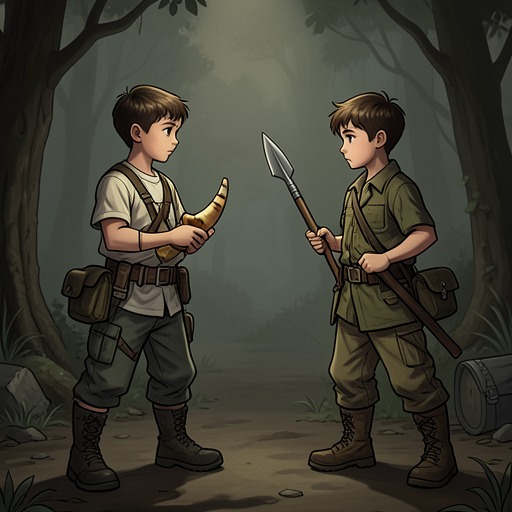
Jack Merridew reaches the top first, his face smeared with clay and his spear raised. He excitedly explains that the hunters crept up on the pig, formed a circle, and killed it. The twins grin as the carcass drips onto the rock. Jack dances briefly, then checks himself; he notices the blood on his hands, grimaces, wipes them on his shorts, and laughs. His account dwells on the thrill and skill of the hunt, while Ralph’s attention remains fixed on what the hunters have neglected.
Ralph answers Jack’s excitement with the accusation, “You let the fire out.” Jack initially brushes this aside, saying they can relight it and inviting Ralph to join the hunt. He is still absorbed in the exhilaration of surrounding and killing a living animal, and boasts about the blood. Ralph repeats the charge. Only then does Jack look uneasily between Ralph and the twins, admitting that he needed everyone in the hunting ring. His explanation exposes the choice behind the missed rescue: the boys assigned to maintain the signal were drawn into the hunt instead.
When Ralph points out that a ship had been visible beyond the island, the hunters’ celebration falters. He makes the lost possibility concrete: they might have been seen and gone home. Piggy joins the protest, blaming Jack Merridew’s hunting, while Ralph invokes his authority as chief and contrasts the hunt with the unfinished shelters. Jack counters that they needed meat and that the job had required everyone. The argument sets two urgent claims against each other—food and the collective exhilaration of the hunt against shelter, the signal duty, and the chance of rescue—and makes clear that the cost of Jack’s decision cannot be dismissed as a brief lapse.
The Argument Turns to Violence
Jack’s defense—that the hunters needed everyone to form a ring and needed meat—does not settle the dispute. Piggy repeats that Jack had promised to keep smoke going, and several hunters wail in agreement. Their protest intensifies Jack’s humiliation: he steps toward Piggy and drives a fist into his stomach, then strikes his head. The argument over the extinguished fire has become physical, and Jack’s attempt to silence the person naming the neglected duty makes the group’s conflict harder to contain.
Piggy’s glasses fly off and tinkle on the rocks. He cries out in terror and searches for them by touch, but Simon reaches them first and returns them. The glasses, which could help relight the fire, are now also the immediate object of Piggy’s helplessness after Jack’s blows. The hunt has ended not only in a missed chance of rescue but in an assault on the boy who protested it, while the others watch the competing claims of leadership, hunting, and responsibility break into open violence.
The Hunt’s Reversal
The scene’s sharpest contrast is not merely between hunting and rescue, but between two incompatible ways of measuring success. Jack’s account celebrates tactics, skill, and the exhilaration of overpowering a living creature; Ralph keeps returning to the ship that may have carried them home. Even as Jack argues that the hunt required everyone, he transfers his bloodied knife to his other hand and smears blood across his forehead. The gesture leaves the hunt’s triumph visibly marked on him, while the empty horizon gives Ralph’s repeated insistence its force. The boys have killed a pig, but the celebration cannot undo what the unguarded fire has cost.